Sunday, May 11, 2014

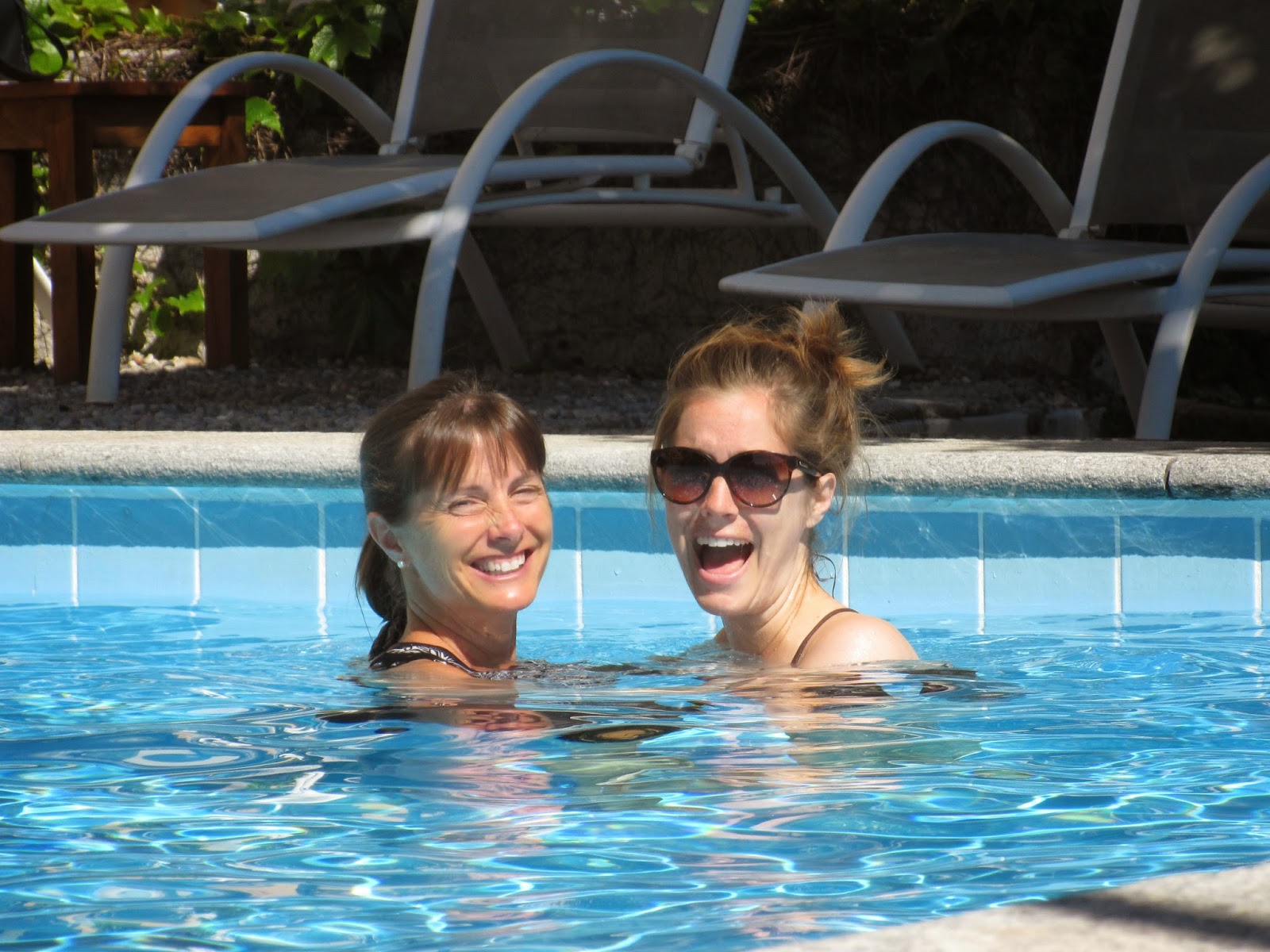
Guest Post: My Mama


Dear  Kate,

What an amazing two weeks we have had. I have fallen in love with your little part of the world, honey. Who wouldn’t? You asked me for my impressions a couple of times during our trip and I thought I would jot them down for you.

It all began with a grand impression when you kicked  off our arrival with a soul filling drive over hill and dale as we stood up through your car sun-roof (and Jordan drove very slowly and safely) to experience the full effects of the apple blossoms at their peak of bloom and fragrance. Everywhere we glanced there was another hillside covered with flowering trees!


Another day, ambling down country roads touched something deep in each of us as we encountered bleating baby goats and sheep…bleating at times a little excessively as you lured them into their electric fence…(totally by accident).


I loved our hike through the Black Forest, and it struck me so powerfully that these were in fact the very same woods through which Little Red Riding Hood and Hansel+ and Gretel traversed during their own flirtation with danger. Though I don’t remember reading that they had a close encounter with a wild boar (or maybe just thought they heard one once).


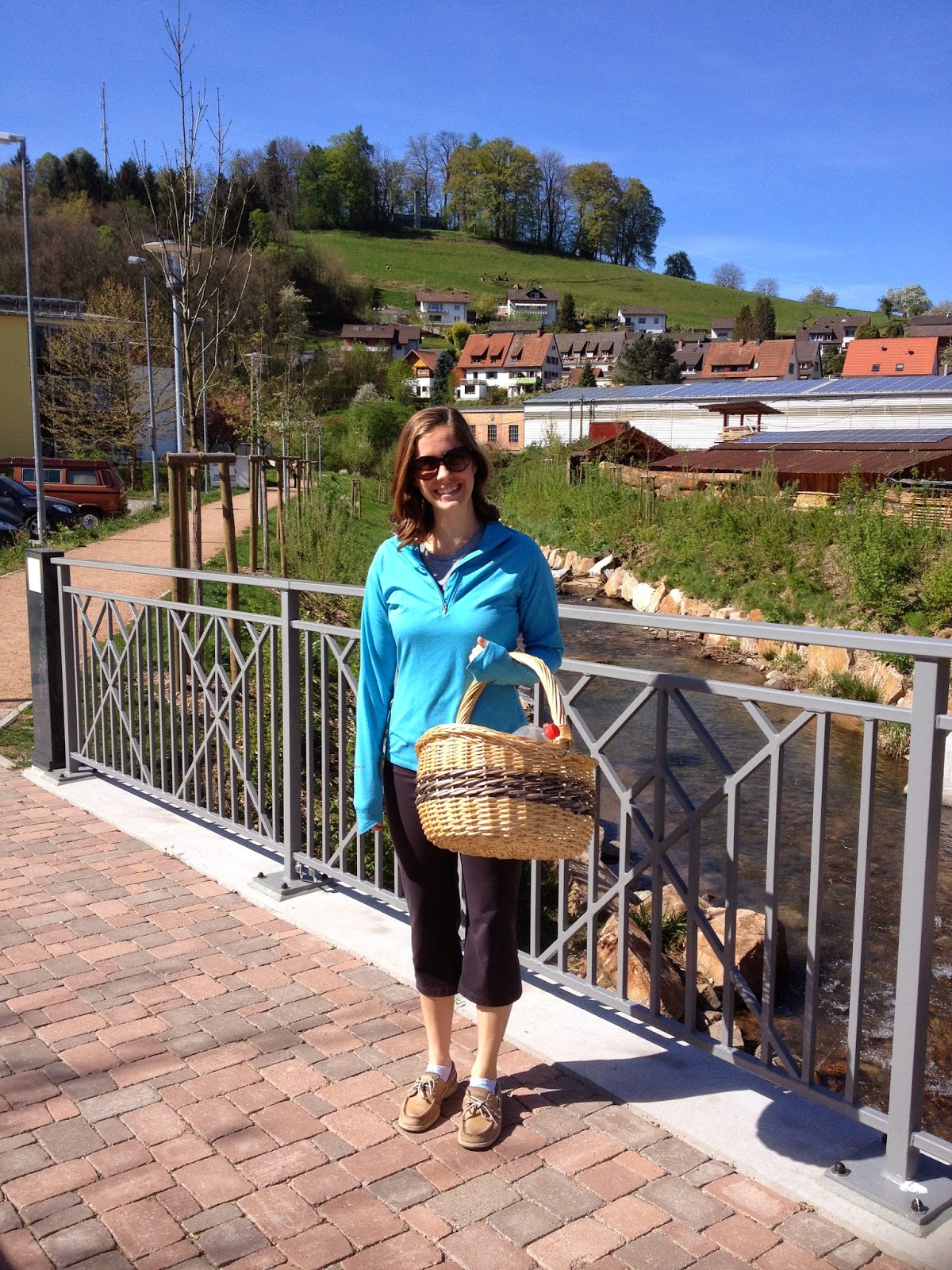
I easily and eagerly fell into your life’s rhythm of getting your bread from the bakery everyday and taking your basket to walk to the market to pick up your fresh produce (Is there a village more suited to Kate Jones than this?)

 It took me a full 10 days to realize that kucken and streusel were not in a breakfast food category, but rather desserts…


Who knew? Who wanted to know?

Several things about those living in Kandern inspired me. One was the high value put on gardening. No matter how small a space, it was made beautified by something in bloom. Every corner, nook and cranny had been cared for in this way.


I also noticed and was inspired by Kandern’s (or more accurately Germany’s) elderly. Of course there were able bodied people of all ages bicycling and walking all the time, but what I loved was how the elderly got out there on their canes and rolling walkers walking the same paths they had been walking all their lives, and likely that their grandparents and great grandparents had been walking all their lives. They didn't seem afraid to fall or to be walking alone– they seemed driven to walk and get outside. And they walked long distances!


Remember the dear man we met upon arriving at Sausenberg Castle? (that castle the we drove to?)  I was blown away that he had actually walked there... from Lorrach! I love that the walking trails all over the countryside have connected these villages for hundreds of years. This is just a way of life here! It's an old way of life that holds on to things of value like spending time outside walking and gardening. I saw many, many people eating and laughing together outside on old tables with plastic table cloths – it didn't look like a Martha Stewart Living magazine – it didn't have to. It was real and the connections were real, and that’s what made it beautiful. I’m sure I am making it much better in my imagination than it really is. But that’s ok – I was on vacation.

It is obvious upon arrival in Kandern that the buildings you see are old (and beautiful). I think that this undergirds a way of life that is old (and to me, beautiful). Living in a village you never have to leave and in which you can walk everywhere; to church, to the market, to the bakery, to school, to your grandparents. It slows life down a bit; you chew on it longer, savor it more. This was very attractive to me. I walked around Kandern a lot looking at the funny shaped houses and gardens – never sure whose garden belonged to whose house.


But whose ever garden it was was very invested in it – they were beautiful! I had so much fun walking all over Kandern while you guys slept in. The cemetery was amazing – a garden in itself – people actually went to the cemetery and took care of the plots – at least during Holy Week.


And in my mind I made it be that the people who watered (with the watering cans at the cemetery for this purpose) valued those who went before them and had a sense of the importance of personal and family history – it mattered – it wasn’t disposable.

On our last night I felt it again as we went up the hill to the war memorial. It was a beautiful place to see the sunset – but I was also drawn to the other side of the hill overlooking the village of Kandern. It was very poignant to me sitting in the shadow of the monument which had a long list of names of those killed at war…an identical list exists in the town square in our Lake Bluff – sons, brothers, husbands and fathers– all who died – all who were deeply missed by those in their respective villages…


I loved what I saw and felt in Kandern; there was a life there that felt deeply connected to the village – I felt it and I loved it. So my darling, these are my impressions of your wonderful village as seen through my rose colored glasses. Thank you for a wonderful trip to a very special place that touched my soul.                    

I love you,

Mom.                                                                                                                                                                                                                                       


Thursday, May 8, 2014

Austrian Scones

For the past few months, I've had this nagging feeling that my blog was missing something...I think it really hit me after I wrote the recent post about what Germany sounded like, and thought about writing a post about what Germany smelled like. I'm an "S" on the Myers Briggs personality test, and from what I understand, that means the five senses are really important to me and I experience life largely through the aesthetics of my surroundings. So, that naturally led me to think about what Germany tastes like.

It's no secret that, for me, Germany tastes like bread. Whether it's a soft, buttery, braided roll, a thick, salted pretzel, or a cute little brotchen, crusty on the outside and (preferably) warm on the inside, Germany has a bread for you. And lots of bread for me. How I will ever go back to eating gluten free after this year remains to be seen, but Germany tastes like other things, too.

For us, Germany tasted a lot like frozen pizza the first month. We were too overwhelmed to do anything but turn on the oven--and even that took a surprising amount of effort. How hot is 200 degrees Celsius, anyway? What do all the settings on our oven even mean? And, oh yeah, the directions on the pizza box aren't in English.


But alongside the frozen pizza, Germany also tasted like yummy homemade meals created by generous new friends who insisted we not bring anything. (And that was probably for the best in our seemingly endless jet-lagged state, barely able to leave the grocery store with food, much less identifiable food that tasted good.) In the first two weeks of our arrival, we probably had ten dinner invitations. I couldn't get over that sweet, tangible way people reached out to us.

Since then, Germany has started to taste like new recipes, for a variety of reasons. Not every food we used to get in the states is easily available in Germany. In case I haven't made it clear, crunchy granola bars are notably missing from this country, as are good salsa and good tortilla chips (according to Jordan) and chocolate chips. And sometimes, even if I can find the same foods, they are more expensive, or just different than I'm used to. My avocado choosing abilities have gone out the window since moving here, which has been tough, because I LOVE avocados. (And on that note--feel free to skip this part if you aren't into avocados--but I think picking out avocados calls for different skillsets depending on where you live. Each time I've made a major move, it's taken about a year of adjustment before I hone my avocado picking skills to perfection again. What would be a perfect avocado in Florida will be far too mushy in Colorado! It's maddening. In Germany, the ones that feel "perfectly" ripe, have already turned brown inside and are starting to rot. And yes, I know the pinterest idea about popping off the little nub to see the color underneath that will tell you if it's past it's prime, but did you read my post about the German grocery store? You aren't supposed to touch the fruit unless you are going to buy it! There are plastic gloves available if you absolutely need to squeeze a pear or sniff a peach. I usually try to stealthily squeeze an avocado while doing the one thumbed nub pop off, but it's hard. Maybe the stress is what's causing me to lose my skills. Anyway.)


Another reason my recipe repertoire has changed, is that my thoughtful friend, Julia, gave me the book "Bread and Wine" which is filled with sweet stories and yummy food ideas. And finally, being in Germany has connected me to new people who have new recipes to share. So, these days, along with some of the usual standbys, I cook things like ratatouille, crepes, and enchiladas (a challenge with the lame salsa, by the way).


But the point of this post is not to talk about dinner foods, or even avocados; it's actually to tell you about the yummiest of treats I discovered how to make this winter. I was introduced to these scones by my friend, Katrina. She is the much-loved history teacher and vice principal of the middle school here at BFA. She made these scones for a staff breakfast and was kind enough to share her recipe. Though she doesn't recall where she learned to make these scones, I have dubbed them, "Austrian Scones", since Katrina grew up in Austria, and that's just the coolest.


My friend Johanna (who is pictured baking with us) and I love these scones so much that when we get together to work out, we usually just end up baking and eating them instead. Jordan loves these scones so much, he keeps asking me when "we" are going to make them again. To be fair, I think he learned that language from me--ie "Could "we" take out the trash today?" "Maybe "we" can change that light-bulb soon?" Personally, I've had a soft spot for scones ever since working at a tea house in college. Really, my love was for the clotted cream, the scones were just an acceptable vehicle for stuffing cream into my mouth. All five of my roommates also worked at this tea house from time to time, and we took turns spying on our boss as she prepared her secret clotted cream recipe, but we never did succeed in getting it. So, I would recommend just whipping up some whipping cream with a bit of sugar, and it will do the trick.


So, with that, I give you my very first blog recipe, Katrina's Austrian Scones. It's even in cups and Fahrenheit, not grams and Celsius, so consider yourself lucky.

Ingredients:                 2 cups flour
                                    ½ cup sugar
                                    2 tsp baking powder
                                    ½ tsp salt
                                    1/3 cup butter
                                    ½ cup whipping cream (I sub almond milk, but cream tastes better, obviously)
                                    1 egg
                                    1 ½ tsp vanilla
                                    cranberries, white chocolate chips, other “mix ins” (the white chocolate is key)
                                    1 more egg for glaze
Directions:
1.    Preheat the oven at 350 degrees F.
2.     Stir together flour, sugar, baking powder, and salt.
3.     Using a pastry cutter, “cut” in the butter. (This part is hard, don't give up).
4.     In a separate container, stir together the cream, egg, and vanilla.
5.     Mix the wet into the dry ingredients. You may need to use your hands to knead the dough.
6.     Add in the cranberries and white chocolate chips.
7.     Spread on a floured surface. Form into a circle and cut into triangles. (Makes them look very authentic).
8.     Beat the other egg and brush onto the tops of the scones. (Optional, but again, adds to aesthetics).
9.     Bake 15(ish) minutes.
10. Enjoy with clotted cream or jam.


Saturday, April 5, 2014

What Germany Sounds Like

Yesterday I came home to a new view outside our bedroom window. Our neighbor chopped down his tree, and in doing so, gave us a lovely cut of sky previously hidden by an enormous evergreen. The absence of the tree changed more than our view. No longer does a choir of birds began rehearsal at 4:30 am outside of our window. I'm afraid the tree housed several apartments of birds who have now been displaced.


For a while I thought it was only our corner of Kandern, but our friends, Ben and Mary, visited from Denver last week, and Mary remarked on how many birds there were in Germany. I began to realize that birds were chirping all over Kandern at all hours of the day and night. I suppose this is part of living in a forest. Or at least the Black Forest.


This got me thinking about the sounds of life in Germany and how people connect their experiences with sounds. You know how sometimes a song comes on the radio and stops you in your tracks and suddenly you're back in college again and you haven't felt that feeling since...the last time you heard that song? I'm sure there are songs that will someday remind me of Germany, but there are other sounds, too.

And try as I might to give you a picture of what life in Germany is like through stories and pictures, I can't explain it fully without telling you how Germany sounds. So, in honor of the poetry unit we're doing in English class, I give you my free verse poem (and some pictures) about what Germany sounds like.

Germany sounds like birds, laughing and reveling in their Black Forest home.


Germany sounds like church bells, consistently tossing out musical confetti on the hour.


Germany sounds like barking dogs-though each is legally allowed only half an hour per day.

Germany sounds like the rev of a manual engine that I still have not tamed.


Germany sounds like quiet, while shopping in stores I used to expect to play music.

Germany sounds like, "Choos!", the sing-songy farewell after every bakery transaction.

Germany sounds like the river, running loudly through town.


Germany sounds like buses, running even louder.

Germany sounds like middle schoolers singing through the halls, "Let it go! Let it go!...The cold never bothered me anyway."


Maybe next week I'll tell you what Germany smells like! :)

Tuesday, March 25, 2014

Why My Monday Afternoons Are More Exciting Than Yours


There are some opportunities in my life that I never imagined I'd have. Teaching middle school being one of them. Teaching 6th grade health and presenting the puberty talk to a group of giggling girls was another. But even more surprising than both of those, is that for the past six months, I have been a part of the middle school strategy games club. Well, not just a part, but the teacher sponsor. Every Monday afternoon, I spent an hour and a half attempting to conquer the world, or rid the earth of deadly diseases, or just trade two sheep for an ore so I can build a settlement with a handful of awesome middle school students.


How did this come to be?...I asked myself the other day. I used to scoff at my guy friends in high school who spent hours "settling". Trading wood and wheat and bricks and building roads and settlements just didn't appeal to me. The game "Dominion" sounded way too intense to be fun. And to be honest, I didn't really know about any other games. Except one. There was that one strategy game that my father began training me in at the age of eight. Risk.

Risk was a staple of Saturday afternoons at the Terrill house. Mom was never that into the game, but when she started dinner, Dad and Cody and I would pull out the original 1975 game board and divide up the countries. Dad advised us on who to attack, how many dice to roll, and how many men to deploy at the end of each turn. (It probably looked more like someone playing chess against themselves, but at least Cody and I thought we were playing.) After ten solid years of Risk training, I went off to college, where I played a handful of times. Several years ago, we bought my Dad the updated version of the game to play on family vacations since his was starting to fall apart. But it wasn't until I was asked to sponsor Strategy Games Club that I encountered a game of Risk like none I'd ever been a part of.


 First of all, I have learned that many middle schoolers are not as concerned with the rules as they are with other things, like winning, or the snacks. And I'm all for being laid back, but I've also developed an appreciation for the German way when it comes to following rules. Thus  a battle commenced inside me between wanting to follow the rules and force others to follow them with me, verses recognizing this was not a class I was teaching and trying to be more easy going, like the students, and focus more on the snacks.

Perhaps this was just a version of Risk that I'd never played, but we began, curiously enough, by trading. The dealer passed out all the cards and soon the boys were calling out, "Who wants Brazil?" "I'll trade Western Europe for South Africa!" I refused to trade, thereby not completely giving away Australia (every good Risk player knows that whoever holds onto Australia always wins the game). The gentlemen with whom I was playing took full advantage of the trading rule, though, and most of them ended up with a complete continent to themselves before the game officially began. We were then instructed to place ALL our extra men on the board. It was complete chaos--impossible to tell where one country began and another ended. Impossible to even see the names of the countries.


This was not a huge problem for me, and I obviously owe that to the extensive Risk training I received when I was in middle school. Yet I worried for the boys, some of whom had never played Risk. I should not have been surprised to discover, though, that most of my fellow players already knew the names of the countries. And not only that, but they had lived in several and also spoke their languages.


Teaching at BFA this year has changed my perspective on many things large and small. It's fascinating to see how the students here bring such unique viewpoints because of the various places they've lived. They look at a Risk board, or world map, with a familiarity most of us only have for our native country, because of their global mindset. My role as Strategy Games Club teacher sponsor is coming to an end as it becomes an elective the last quarter, but I'm grateful for the new perspective I'll have each time I play Risk, both in global awareness, and in the optional trading rules.


P.S. Vadim ended up winning the game that day by putting all his armies on his home country of Ukraine, and plowing through Europe, into North and South America, up through Africa and Asia, and finally conquering Australia.

Thursday, March 6, 2014

Doubts Part IV: The Surprising Conviction


The funny thing about these doubts, the searching, and the resolution I felt, is that it was short lived. Though I found answers to my questions, and peace about my faith, I also found something I hadn't set out to find: conviction. The kind that feels like a punch in the gut and makes you wonder what you've been thinking all these years...

It began, actually, through a Christian romance novel I was reading while I worked-out. (God works in mysterious, and sometimes embarrassing ways.) You see, there are people in my life who have really hurt me. And over the years I've blamed some of them for many of my own insecurities and much sadness. Well, through this book, God showed me how similar I am to those people. I am no better than them. In fact, I've acted in many of those same hurtful ways. I just refused to see it that way for many years...justifying my sin and playing the victim from theirs.


And as if that realization wasn't sobering enough, it struck me that I was actually much worse than them. Because among other reasons, I call myself a Christian. I knew better than to act in those hurtful ways. Through all these years, I just never saw it that way. But when you're too busy nursing your wounds from someone else's sin, it's hard to stop and consider your own guilt. It was as if I couldn't face my own wrongdoing. You see, I had tried so hard my entire life to be good. Admitting my guilt in this area was admitting that I had failed. But not admitting my guilt meant something much worse than failing...

"If you are avoiding sin and living morally so that God will have to bless and save you, then ironically, you may be looking to Jesus as a teacher, model and helper but you are avoiding him as Saviour. You are trusting in your own goodness rather than in Jesus for your standing with God. You are trying to save yourself by following Jesus. That, ironically, is a rejection of the gospel of Jesus." -Timothy Keller, A Reason For God

Why exactly had I tried so hard to be good? Was it so that God would "owe me" a happy life? Is that why I became angry, when despite my efforts, life didn't go as planned? I-did-my-part-why-wasn't-God-doing-his-part kind of attitude? Coming to terms with the idea that I wasn't as good as I thought, was no longer just making me feel uneasy, it was uprooting my perspective of myself and of God.


"The Christian's identify is not based on the need to be perceived as a good person, but on God's valuing of you in Christ." Clearly I don't live by that belief or I wouldn't speed only when no other cars are around, I wouldn't act busy when my boss came in, I wouldn't pretend to be so good. I would live openly and I wouldn't care so much about how other people perceive me. Unfortunately, my identity isn't based on God's value of me, it's based on being good and perfect and pretty and charming and cheerful and spiritual and witty and happy and peaceful and content. It's based on being a really good Christian.

I am deeply sorry if my attempts to be seen as "good" have worked. It pains me to think that I may have fooled anyone into believing that the standard for Christianity is too high...because while I may have carefully avoided the "really bad" sins, and looked good on the outside...I was like an apple that had been eaten by worms on the inside, rotting and moldy yet perfectly smooth and shiny at first glance. That is the painful truth.

And it's also true that there is no "standard" in order to be a Christian. Contrary to the way I live my life, you don't actually have to be really good to be a really good Christian. There's only one qualification: be a sinner. Be broken. Be empty. Be in need. Come empty and let Christ fill you up. Find your identity in the only person who has ever loved you perfectly. I invite you, along with me, to stop trying to be so good, and let Christ's goodness be enough.


P.S. If you're thinking of starting a blog about what God is honestly teaching you...I must warn you to consider carefully. He may use this time to teach you some painful, embarrassing, and hard lessons.

(This is part four of a series of journal entries and research I've been working on for the last month or so. Click for part onepart two, and part three.)

Wednesday, March 5, 2014

Doubts Part III: Finding Answers, or My Grown-Up Book Report

(This is part three of a series of journal entries and research I've been working on for the last month or so. You can find part one here, and part two here.)


January 12, 2014

I love libraries. And I tend to think that any problem can be solved by a trip to the library. Need to learn about real estate or plan a trip? The library can help! Too embarrassed to buy a People magazine to read up on British royalty? Check out the back-issues at the library! Can't cook? The library has a whole cook-book section! The library is the answer to life's problems big and small. It is no surprise then, that my initial acknowledgement of the doubts I was struggling with regarding my faith was followed by a trip to the library. And I piled on the books--Mere Christianity, The Case for Christ, Escape from Reason...But it was A Reason For God by Timothy Keller that I began to read first.

In it, I found loads of compelling evidence for the existence of God...(I recommend you go ahead and read the book, but if you're short on time, the highlights I found most intriguing are below.)


*Keller cites Robin Collin's, "A Scientific Argument for the Existence of God: The Fine-Tuning Design Argument", that highlights fifteen constants in our universe, that, were they off in their exact values by even one in a million, our world could not have existed. Since that fact is a bit heady and hard to grasp, Keller borrows philosopher John Leslie's analogy. If an expert firing squad of fifty men all shot at a target that was six feet away, and no one hit the target, it is possible that it was an accident, but not probable. Likely, they all missed on purpose. Similarly, it's possible that all the necessary constants just happened to align on their own so that our universe could burst into being, but it's not likely.


*Keller brings up St. Augustine's Confessions and his theory that unfulfilled longings are proof of God's existence. If we are hungry, if we desire food, it doesn't necessarily mean that we will eat, but doesn't it prove that food exists? The thing is, we have longings much more powerful than hunger...longings for meaning in life that even a really great career or family can't satisfy; a desire for love that even the sweetest relationship can't ultimately provide; and a desire for happiness that is incredibly elusive, constantly slipping through our fingers. But we still long for those things...might it mean that true satisfaction is available somewhere?


*Keller introduces the ideas of the late Yale law professor, Arthur Leff, who writes about the great "Sez Who?" argument. Namely, if there is no God, there is no basis for morality and no reason to be moral. You may say that slavery or murder or racism is wrong, but the question remains, "Says who?" Some say that nature is the basis of our moral code, but, as writer Annie Dillard points out, nature is extremely violent. It is not wrong for a lion to kill a deer, but we consider it wrong for a stronger human to kill a weaker one. Therefore, nature cannot be responsible for our morality, so there must be a higher power than nature from whom we glean our moral code.


*Keller argues that deep down, we know this moral code exists. "We all live as if it is better to seek peace instead of war, to tell the truth instead of lying, to care and nurture rather than to destroy. We believe that these choices are not pointless, that it matters which way we choose to live..." Yet if there is no God, then does any of that ultimately matter? "...then the whole span of human civilization, even if it lasts a few million years, will be just an infinitesimally brief spark in relation to the oceans of dead time that preceded it and will follow it. There will be no one around to remember any of it. Whether we are loving or cruel in the end would make no difference at all."


Then I came across this quote: "If Jesus rose from the dead, then you have to accept all he said; if he didn't rise from the dead, then why worry about any of what he said? The issue on which everything hangs is not whether or not you like his teaching but whether or not he rose from the dead." I was feeling pretty good that I basically came to the same conclusion as Keller, and also feeling hopeful that he was going to address this question on which lay the crux of my doubt. The basis for much of what he writes in this chapter comes from NT Wrights, The Resurrection of the Son of God.

Again, you should probably just turn off the computer and go read the chapter, "The Reality of the Resurrection", but if you want the much less eloquent (and shorter) version, here it is. If Jesus didn't rise from the dead, how and why did Christianity begin? Some people argue that the story of Jesus's death changed with each telling, like a tall-tale, till suddenly he had risen from the dead(!); but anthropological studies tell us that in those times, "historical accounts were not allowed to be changed" and that fact and fiction in history was clearly differentiated. Also, the first Biblical writings citing the empty tomb (1 Corinthians) appeared only fifteen to twenty years after Jesus died, and mention over 500 eyewitnesses to his resurrection. This means that many of those people were still alive and available to share their account of seeing Jesus. Also, if the gospel accounts really were fabricated, the authors would never have picked women, whose social status was so low that their testimony was not considered valid evidence in court, to be the first witnesses to the resurrection. This evidence may not be enough for us, though, and we may imagine that people in those days were more gullible to an event like resurrection than we would be today. However, research shows the resurrection would have been unbelievable to both Jews and Greeks at that time. This makes a conspiracy by the disciples, as well as mental delusions on their part improbable because the idea of a resurrection wasn't something they, or those they were trying to convince could have even conceived. We know there were other people claiming to be the Messiah back then. All of them eventually died. Why didn't Jesus's disciples assume that his death meant that he, too, was a fraud, unless there was evidence proving otherwise?

Well, the library came through for me again.  I found the evidence compelling and affirming. I was, however, unprepared for what else I found...


Tuesday, March 4, 2014

Doubts Part II: Five Beads


January 7, 2014

I don't have a New Year's resolution yet. I suppose confronting these doubts would be a good one. So, on a solitary walk along the riverside, I start to think, "What is it I'm really doubting?"

I remember back to the beaded bracelets I used to make in VBS. Five colored, plastic beads, all representing God's plan of salvation. Green, Black, Red, White, and Gold. First, green, for creation. I'm not super concerned with this one right now. I would side with the creationists in a debate, but if God did use evolution to bring about life, my faith wouldn't fall apart. I think. Maybe I just don't have the energy for this one right now. I really did care during my 7th grade science research paper. And I was ready to fail high school biology before marking "evolution" as an answer on my test. But now...I feel like there are bigger fish to fry, or at least people more passionate and qualified to fry those fish than me.

Next bead: black. For the darkness in our hearts and souls. For the bad things we do or say or think. For the blame I automatically put on my husband when I'm unhappy. For the pride that makes me think I'm better than others. For the unkind words that fall out of my mouth without my permission. For sin. No...sin is not what I'm doubting. The evidence is clear in my life, in those around me, and in society at large. We are not naturally good. I never taught my first graders how to steal their neighbor's crayon, and I didn't teach them to lie about it later. No, it's clear to me that we are born sinful. And so, it naturally follows that we need help. We need to be saved.

That is the truth that I know about man. About God? Well is it even possible to have sin without God? If there's no one higher, then who's to say that stealing and lying are wrong? There isn't anyone to say that, in fact. Why would it even be important for my first graders to stop stealing crayons and lying about it? What would be the point of being good? Just so everyone can be happy? But being good doesn't always make me happy...hmmm...


Back to God...I think either it's all true, or none of it is. Some pieces are more difficult for me to grasp than others. Heaven, for example, the golden bead, is harder to concede than God. But if I believe in a loving God who created me (green bead), why would He lie to me about the existence of heaven? He not only wouldn't, but in fact, couldn't.

These doubts remind me of my fleeting childhood fear...what if my sweet, loving parents were really witches, raising us, fattening us up, all along planning to boil us in stew and eat us?? It seemed far fetched, but still...even the remote possibility was frightening. (Am I the only one who considered this? Cody??) It also reminds me of the fear I used to have in early high school of becoming anorexic or suicidal. I was afraid (probably as a result of too many preventative, inspirational speakers at high school assemblies) that these things would overcome me and force me to stop eating or throw myself off a cliff despite my will. What comfort I found in my mother's words, "Those things are a choice. You won't ultimately do them if you don't want to." Similarly, my faith is a choice. I can chose to stop believing. Or I can chose to keep believing, even with doubts.

Next bead: red. For the blood. When Jesus died on the cross. Is anyone still actually questioning whether this happened? Jesus's existence--his birth and his death on the cross is a pretty universally accepted historical fact. I'm not concerned about this one. But it's the next bead...the white one...that seems to hold the key to faith. Did Jesus rise from the dead? Did he conquer death so that our sins could be washed away, so that we could be pure and clean like snow? My doubts then, seem to be centered around Jesus, and whether or not He is the son of God who was raised from the dead. If that's true, then all of it must be true.

It puzzles me how much comfort I can still draw from this faith that I'm so busy questioning. To be reminded that Jesus conquered death, so that we have nothing to fear is so calming in the face of news about a former co-worker's brain tumor. Perhaps faith is less of a choice than I think? It seems I cannot help believing whether I want to or not...


(This is part two of a series of journal entries and research I've been working on for the last month or so. You can find part one here, part three here, and part four here.)